I am a cultural-digital geographer and filmmaker who investigates theories, politics, and practices of refusal, and who is directly inspired by critical theory, pessimist philosophies, and radical politics. I specifically examine how a politics of refusal shifts in relation to changing technological and urban conditions, and how, in turn, such negative politics push us to rethink geographical understandings of power, affect, and the human.
Books
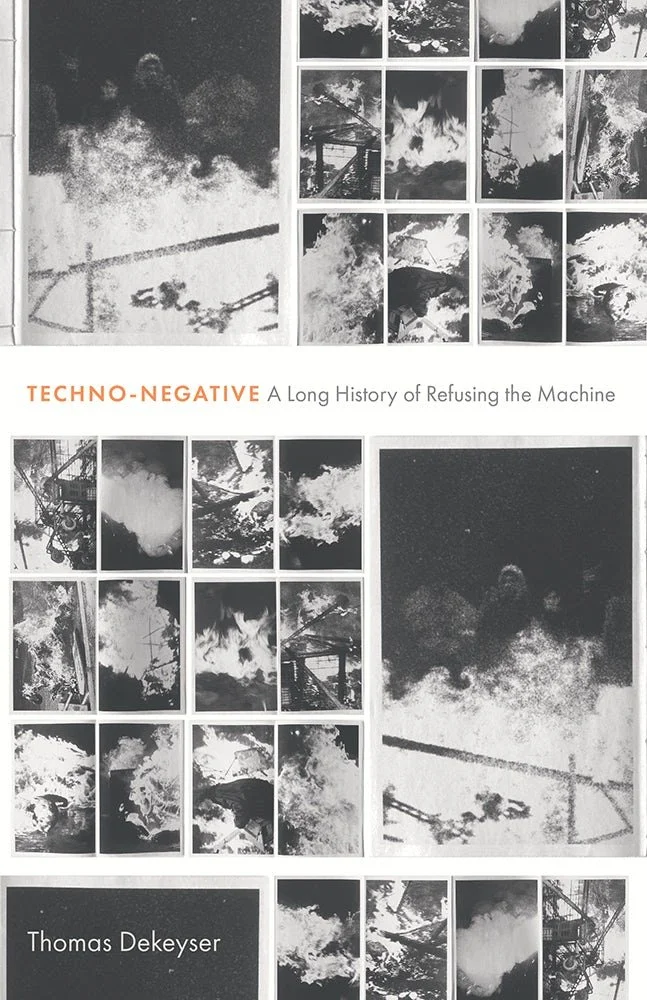
Techno-Negative: A Long History of Refusing the Machine, published with University of Minnesota Press (2026)
"Dekeyser is a crisp and forceful writer . . . provocative and enjoyable . . . [Techno-Negative] provide[s] inspiration for thinking against today's dominant technologies." —The New Yorker
The history of technology is often told as a history of progress, moving optimistically from one emancipatory invention to the next. Techno-Negative turns this story on its head, taking us on a journey to the critical junctures where people have long recognized and resisted the machine as a violent, sometimes deadly force implicated in defining who counts as human. Thomas Dekeyser argues that technologies operate as “ontological policing,” drawing the boundaries of humanness as they are unequally leveraged by select groups.
Looking beyond the Luddites to medieval monks banning tools, seventeenth-century loom burners, revolutionary lantern smashers, and computer arsonists, Dekeyser challenges us to rethink the ubiquitous demands to reform or accelerate technological “advancement” that have failed to disrupt our present. In a time when Big Tech grows increasingly enmeshed with authoritarian control, Dekeyser proposes a spirited alternative: abolition. Techno-Negative is a conceptual declaration for those searching for a new paradigm of technological politics.
Articles & Chapters
Oliver, C. & Dekeyser, T. (2026) Geographies of Nothingness: towards void-thinking. Social & Cultural Geography.
Excerpt: “In this Special Issue, we argue for the need to pay attention to the originary nothingness underpinning all social, political, existential, and affective life, and the ways this nothingness is, in our current moment, intensifying in circulation and effect. For our purposes, in this Introduction, we use the term ‘nothingness’ as an umbrella term to encapsulate the various formations and deformations that can only affect in the moment of withdrawal, that is, without directly presenting itself. While, as we note in the next section, geographers are increasingly underscoring the urgency of paying attention to its specific articulations – voids, negatives, holes, abysses, absences – we specifically call for attention to the situated, embodied manifestations of this nothingness. In their own ways, and following distinct philosophical and epistemological lineages, the contributions in this Special Issue hone in on specific empirical iterations of nothingness and the affective, material, and political work these conduct. The result is a multi-faceted understanding of nothingness as a doing across a range of registers.”
Lynch, C. & Dekeyser, T. (2026) AI Refusal: A Cultural Politics.cultural geographies.
“Artificial intelligence (AI) systems are producing and solidifying uneven relations of power and, thus, also altering the stakes, mechanisms, and possibilities of refusal. The questions we ask in the papers included in this special issue are: What are the possibilities and stakes of refusal in a world saturated with the spaces, infrastructures, affects, algorithms, and discourses of AI? How might AI alter, diminish, or expand the capacities for digital refusal? To address these questions, we argue, it is crucial to understand AI as a deeply cultural regime whose battle for adoption and development is fought in the domains of aesthetics, economies, identities, cultural production, and knowledge. Recognizing the ways that subjects and places differentially encounter and make sense of AI and its effects in the spaces and rhythms of everyday life, the contributions in this special issue examine cultural practices as potentially privileged, if messy and imperfect, sites of AI refusal. Each paper offers a different vantage point to consider the complex relational and spatial entanglements between humans and AI, presenting different perspectives on what exactly is refused in practices of AI refusal.”
Dekeyser, T. (2026) Abolish. In: The Routledge Handbook of Cultural Geographies (edited by Merriman, P., Secor, S. & Sumartojo, S.).
“Abolitionism starts from the belief that a particular arrangement (social, economic, material, institutional) is broken to the point it can no longer be salvaged. While the recent decades have seen a burst in abolitionist forms of study and practice, giving rise to energetic intellectual movements and street politics, cultural geographers have appeared more hesitant. The aim of this chapter is twofold. First, it diagnoses the subdisciplinary reluctance to embrace the abolitionist invitation, pointing in particular to the popularisation of a relational metaphysics and of an ethics of world-making. Second, the chapter offers a call for abolitions: of the myth of realism, of the bias towards world-building, of the conflation of emancipation with positive feeling, and of the urge towards concessions. Pursuing such endings, cultural geographers may find tools to critically engage, and if needed to explicitly confront, reformist investments in what ultimately harm us.”
Dekeyser, T., Lynch, C. & Maalsen, S. (2025) AI Authoritarianism: Towards an Analytical Framework. Transactions of the Institute of British Geographers.
“This intervention offers a call for investigating the deepening alignment of artificial intelligence and authoritarian politics. The paper highlights three key features of AI that inflect the workings and logics of authoritarianism: (selective) inhumanisation, the cult of intelligence and scaling. We argue that AI, through these features, is not simply extending, but actively modulating, key dynamics of authoritarianism. To account for this, we propose a flexible analytical framework designed to grapple with the rapidly changing materialisations of the confluence of AI and authoritarianism and suggest focusing on how what we call ‘authoritarian tendencies’ are introduced on the level of the techno-material, the ideological and the everyday. The framework recognises that both AI and authoritarianism are relational practices and thus requires geographers to trace these relations across multiple sites and actors while being attentive to the ways AI and authoritarianism mutually shape one another in ever-shifting ways.”
Dekeyser, T. & Whitehead, M. (2024) What is artificial about artificial intelligence? A provocation on a problematic prefix. AI & Society.
“When in the pages of this journal and elsewhere, we write ‘artificial intelligence’, what exactly do we mean? What is ‘artificial’ about the emerging forms of ‘intelligence’ we are interested in, and how do the terms heighten our ability to understand and regulate them?”
Dekeyser, T. & Lynch, C. (2024) Control and Resistance in Automated Shops: Retail Transparency, Deep Learning, and Digital Refusal.Antipode.
“Through the enrolment of big data, deep learning, sensor fusion, and computer vision technologies, Amazon Go and similar shops pursue the automated management of retail subjects, goods, and transactions. Tracing the logics of automated shop technology, the paper makes two contributions. First, it proposes a theory of “retail transparency” to attend to how automated shops reimagine space as a series of pockets of excess (actions that escape circuits of capitalist valuation) to be countered through acts of making-transparent (datafication for integration into digital systems of control). Retail transparency is underpinned by interventions aimed at perceiving, incorporating, and productivising excess. Second, we argue that logics of deep learning raise important challenges to traditional conceptions of resistance in digital geographies, as these tend to rely on a celebration or cultivation of excess. Instead, we offer a speculative reflection outlining a politics of “circuit-breaking” which refuses to engage algorithmic logics on their own terms.”
Dekeyser, T., Zhang, V. and Bissell, D. (2023) What should we do with bad feelings? Negative affects, impotential responses. Progress in Human Geography.
“Bad feelings are everywhere. When faced with this situation in our empirical encounters or conceptual analyses, most socio-spatial research is committed to making things right again, with an eye to unleashing new potentials for action by repairing bad feeling. Yet this ‘ethics of rehabilitation’ assumes both the inherent possibility and ethical desirability of working away those affects that are deemed to be ‘negative’. We argue that this activating process risks delegitimising, in possibly troubling or violent ways, the ethical validity of both incapacities (when one is unable to act) and negative capacities (when one decides to not act). Instead of a rehabilitative ethics, we propose an ‘ethics of impotentiality’ that suspends the urge to activate negative affects, offering a radically situated ethical relation that is neither didactic nor moralising, refuses any easy distinction between empowering and disempowering affects, and allows for subjects to stay with inaction.”
Dekeyser, T. (2023) Rethinking Posthumanist Subjectivity: Technology as Ontological Murder in European Colonialism. Theory, Culture & Society.
“This paper centres the colonial pre-histories of ‘the digital’ to complicate posthumanist theorisations of subjectivity. Posthumanism helpfully undercuts human exceptionalism by presenting subjectivity as always-already co-constituted by technology. However, this paper argues that it insufficiently engages the human as the historico-political effect of negating the assumed non-technological colonial Other. Focusing on liberal humanism between the 16th and 19th centuries, the paper theorises the modern human as bound up in ‘technological onticide’. The presumed absence of technology became a (theo-centric, ratio-centric, bio-centric) measure of the Other’s sub-humanity, at the same time as this Other was expected to be humanised through its technologisation. An emphasis on technological onticide complicates universalist theories of subjectivity that take it as always a matter of human-technology co-constitution. The paper argues that, to confront the legacies of ontological murder, conceptual room needs to be made for inhuman, counterhuman or unhuman theories of subjectivity.”
Culp, A. and Dekeyser, T. (2023) A Manifesto for Destructionist Film. Counter-Signals.
“The Destructionist International is dedicated to the negative in all its forms. It is driven by a shared inclination: a taste that carries us toward the fury of destruction and away from the dull submission of situations to reasoned judgement. This passion helps DI maintain a militant indifference toward individuals, organization, and institutionalization of any kind. It owes its existence to radical events, those rare situations in which abolition becomes actual.”
Dekeyser, T. (2022) Worldless futures: on the allure of ‘worlds’ to come. Transactions of the Institute of British Geographers.
“This paper is concerned with the conceptual, discursive, and political inclination within spatial and social thought towards enacting ‘new worlds’, ‘worlds to come’, and ‘possible worlds’. Against the backdrop of this diffuse habit, which I refer to as ‘worldly futuring’, the paper calls attention to the ongoing challenge posed by worldlessness. It asks: what is lost, existentially or politically, in prioritising world-building over world-ending? Articulating a response to this question, the paper examines how the investment in future worlds functions, what it secures, and what it indemnifies against. Definitionally, ‘world’ lacks the ethical designation required to explain its signalling function as a positive horizon of futurity. Worldly futuring instead relies on three connected affirmations: world presents the promise of (meta)stability, of commonality, and of meaning. In prioritising these affirmations, worldly futuring immunises itself against the possibility of their radical absence or violent undoing, thereby working around, against, or sublating the threat of worldlessness. However, building on the scholarship of Derrida on worldless alterity and theorists of black negativity's political calls for the ‘end of the world’, the central argument of the paper is that working-away worldlessness is neither inherently possible nor necessarily desirable. Despite any attempt at immunisation, worldlessness haunts any project of worldly futuring, showing us that the assumed connection between world and futurity may well be an obstacle to radical futures.”
Dekeyser, T., Secor, A., Rose, M, Bissell, D., Zhang, V. & Romanillos, J.L. (2022) Negativity: spaces, politics and affects. cultural geographies.
“This paper reflects on the status of ‘negativity’ in contemporary social and geographical thought. Based on a panel discussion held at the American Association of Geographers Annual Meeting 2021, each contributor discusses what negativity means to them, and considers its various legacies and potential future trajectories. Along the way, the contributors offer ways of attending to negative spaces (voids, abysses, absences), affects (vulnerabilities, sad passions, incapacities, mortality) and politics (impasses, refusals, irreparabilities). However, rather than defining negativity narrowly, the paper stays with the diversity of work on negativity being undertaken by geographers and other scholars, discussing how varying perspectives expand or dismantle particular elements within spatial theory. Collectively, the contributors argue for paying attention to negativity as the faltering, failure or impossibility of relations between body and world, thus situating it in conversation with relational thought, vitalist philosophies and affirmative ethics.”
Dekeyser, T. and Jellis, T. (2021) Besides affirmationism? On geography and negativity.Area.
“This paper poses questions on the possibility of styles of working besides “affirmationism.” The paper begins by defining negativity as a force or status of disunification, and traces how it remains closely associated with dialectics within Geography. The paper goes on to explore how the renunciation of dialectics has meant that negativity more generally has been rendered outside thought, with a concomitant uptake of an affirmationist ethos. Despite the promise of such work, there remains disquiet. What is omitted or elided in the uptake of affirmationism? Critiques, largely from outside the discipline, highlight how affirmationism privileges the lively and Life, novelty and experimentation, and the generous and generative in conjunction with a suspicion of negativity. We home in on and reflect on three ostensible limits of affirmationism: affirmationist vitalism, affirmationist politics, and affirmationist critique. We argue that renouncing dialectics does not entail, necessarily so, a concomitant abandonment of negativity. Indeed, we need to embrace attempts to think and act that elude, or dispense with, the propensity to affirm, making space for affects that are far from hopeful, for those becomings‐otherwise that do not increase capacities to act, or for modes of critique that refuse; in other words, for that which is besides affirmationism or simply “unaffirmable.” Crucially, however, we point towards the dangers of a simple (re)turn to negativity, preferring a steadfast refusal to settle these tensions.”
Thacker, E. and Dekeyser, T. (2020) Pessimism, futility, and extinction: an interview with Eugene Thacker. Theory, Culture & Society. [A pamphlet version can be downloaded here]
“In this interview with Thomas Dekeyser, Eugene Thacker elaborates on the central themes of his work. Addressing themes including extinction, futility, human universalism, network euphoria, political indecision and scientific nihilism, the interview positions Thacker’s work within the contemporary theoretical conjuncture, specifically through its relation to genres of thought his work is often grouped with or cast against: vitalism, speculative realism and accelerationism. More broadly, however, the interview offers a unique insight into Thacker’s approach to the thinking, doing and writing of ‘philosophy’.”